
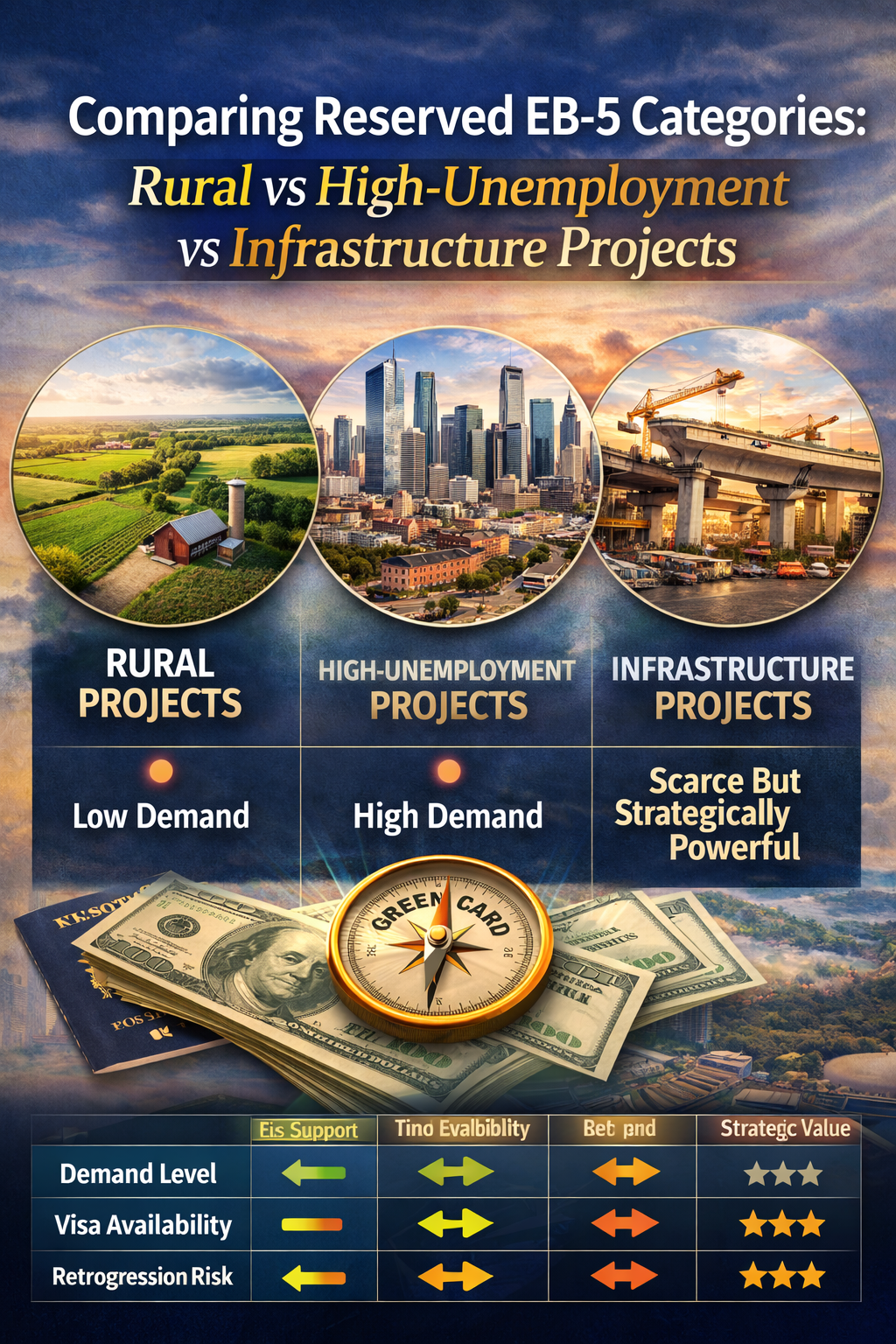
Comparing Reserved EB-5 Categories: Rural vs High-Unemployment vs Infrastructure Projects
The introduction of Reserved EB-5 visa categories has reshaped how global investors approach the EB-5 Immigrant Investor Program. For Indian investors in particular, these categories offer meaningful opportunities to reduce wait times and improve green card outcomes.
While rural EB-5 projects have emerged as the most common choice among Indian investors, availability should not be confused with superiority. Based on post-RIA market realities, a well-structured infrastructure EB-5 project — when available — can offer a distinct and potentially stronger advantage compared to both rural and high-unemployment projects.
This article compares all three reserved categories, with a practical, immigration-first lens for Indian investors.
Understanding Reserved EB-5 Categories
Reserved EB-5 visas were created to:
-
Channel foreign investment into priority U.S. developments
-
Improve visa availability
-
Reduce country-based backlogs
Each year, a specific number of EB-5 visas are set aside for:
-
Rural projects
-
High-unemployment (TEA) projects
-
Infrastructure projects
For Indian nationals, whose EB-5 demand has risen sharply, how these reserved visas are used matters more than the category’s popularity.
Rural EB-5 Projects: Common, Proven, but Increasingly Crowded
Why Rural EB-5 Is Popular With Indian Investors
Rural EB-5 projects are widely chosen because they offer:
-
Priority USCIS processing
-
Historically strong visa availability
-
Faster adjudication trends
These advantages have made rural projects the default EB-5 option for many Indian investors, including H-1B and L-1 holders.
The Emerging Challenge
The popularity of rural EB-5 has led to:
-
Concentrated demand from Indian filings
-
Increased competition for the same reserved visa pool
-
Potential future retrogression as awareness grows
Rural EB-5 remains a strong option, but it is no longer underutilized.
High-Unemployment (TEA) EB-5 Projects: Familiar but Less Differentiated
High-unemployment EB-5 projects are typically:
-
Located in major metropolitan areas
-
Large, mixed-use developments
-
Backed by experienced developers
However, for Indian investors in 2026:
-
Demand is high
-
Visa protection is weaker than rural or infrastructure categories
-
Processing timelines are less predictable
TEA projects often sit in the middle — neither the fastest nor the most protected reserved category.
Infrastructure EB-5 Projects: Rare, Underutilized, and Strategically Powerful
Why Infrastructure EB-5 Deserves Special Attention
Since the passage of the EB-5 Reform and Integrity Act (RIA), there have been very few true infrastructure EB-5 projects available in the market, particularly for Indian investors.
This lack of supply has resulted in:
-
Minimal usage of the infrastructure reserved visa allocation
-
Extremely low competition compared to rural and TEA categories
-
A reserved visa pool that remains largely untouched
When a properly structured, RIA-compliant infrastructure project is identified, it can offer:
-
Superior visa availability
-
Reduced risk of category saturation
-
Strong credibility due to government involvement
-
Clear public-purpose job creation
The Reality
Infrastructure EB-5 is not difficult because it is risky —
it is difficult because very few projects meet the legal, structural, and compliance requirements.
But when they do, the immigration upside can be significant.
Side-by-Side Comparison of Reserved EB-5 Categories
| Category | Demand Level | Visa Availability | Retrogression Risk | Strategic Value |
|---|---|---|---|---|
| Rural EB-5 | High | Good (declining) | Medium-High | Strong |
| High-Unemployment (TEA) | High | Moderate | High | Average |
| Infrastructure EB-5 | Very Low | High | Very Low | Excellent |
Our Strategic View for Indian EB-5 Investors
At US Visa India Services, we believe EB-5 decisions should be driven by immigration outcomes, not market trends.
Our approach is:
-
Infrastructure EB-5 — when a compliant and well-structured project is available
-
Rural EB-5 projects with strong job buffers and experienced sponsors
-
Select high-unemployment projects with early filing strategies
This reflects post-RIA realities, not pre-RIA assumptions.
Final Thoughts: Rarity Can Be an Advantage
Rural EB-5 projects are popular — and for good reason.
But popularity often leads to congestion.
Infrastructure EB-5 projects are rare — and that rarity can translate into:
-
Better visa availability
-
Lower competition
-
Stronger long-term positioning for Indian investors
The key is identifying the right project, not simply choosing the most common category.
Speak With an EB-5 Advisor Who Looks Beyond the Obvious
At US Visa India Services, we actively track:
-
Post-RIA compliant infrastructure opportunities
-
Visa usage trends across reserved categories
-
Immigration-first strategies for Indian investors
 Consult with EB- Visa Consultant In India before you decide — because in EB-5, the least crowded path can often be the smartest one.