
- Blog
Indian H-1B Applicants Stuck in India Face
Growing Uncertainty — Expanded Social
Media Vetting Delays Stamping Until 2026.
Is EB-5 the Fastest Way Out?
Amit Singh
December 11, 2025
Indian H-1B Visa Interviews deferred to 2026
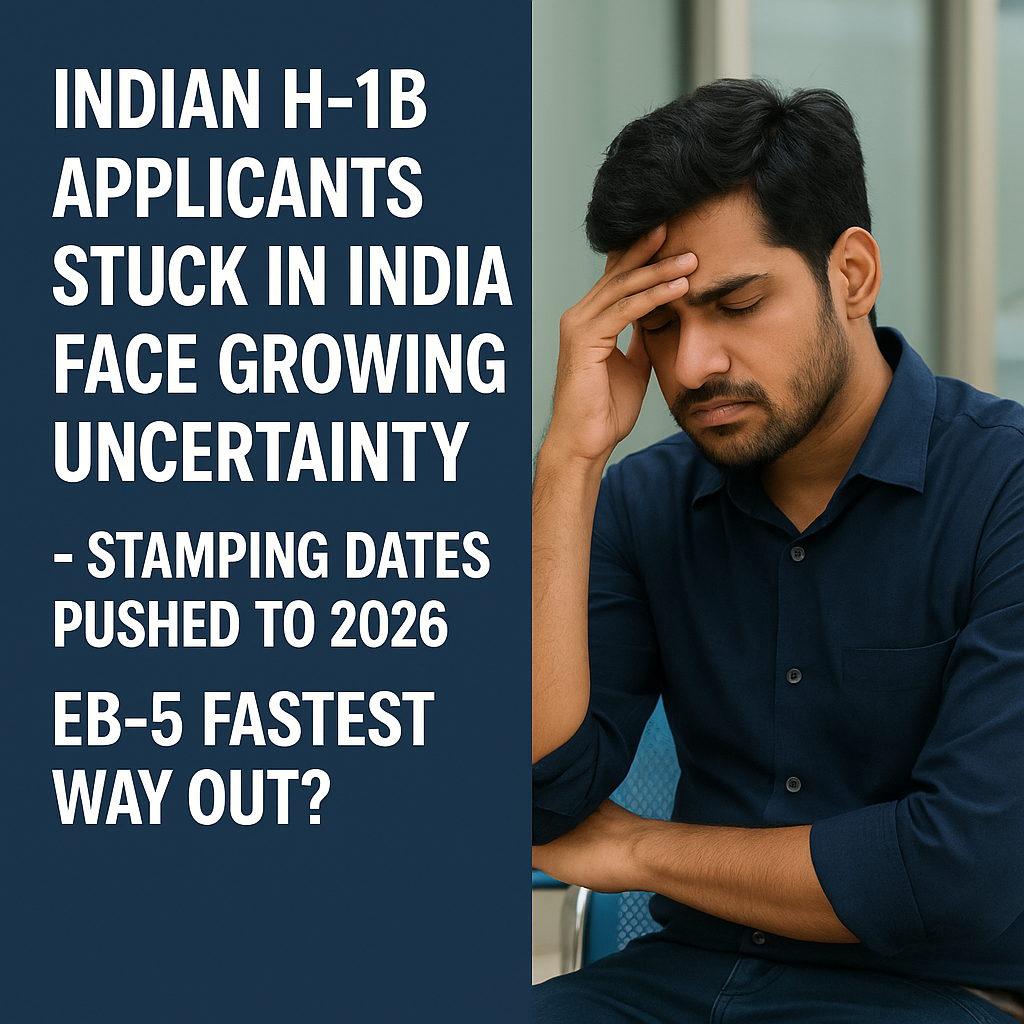
Thousands of Indian H-1B applicants are facing an unexpected roadblock: their visa stamping appointments have been pushed as far as 2026, leaving professionals and their families stranded in India with no clarity on when they can return to the U.S. This situation has created anxiety, career disruptions, and a sense of helplessness for many whose lives and livelihoods are tied to the American work system.
While U.S. consulates have not issued a formal explanation, immigration experts widely believe the bottleneck is linked to enhanced social-media and online-presence vetting, an expansion of background checks that significantly lengthens security review timelines. The result? Even applicants with approved H-1Bs are stuck in administrative limbo.
But amidst this uncertainty, Indian professionals are now exploring a stable and long-term solution that bypasses the entire stamping drama: The EB-5 Investor Visa.
Why Are Indian H-1B Visa Stamping Dates Being Pushed to 2026?
The primary cause behind the delays appears to be:
1. Expanded Social Media Screening
U.S. visa applicants must now disclose five years of social media history, allowing authorities to conduct deeper vetting. High volumes of applicants + more complex checks = massive processing lags.
2. Post-Pandemic Backlogs
While consulates have improved capacity, the backlog continues—especially for India, which sees the world’s highest H-1B demand.
3. Increased Scrutiny on Employer-Employee Relationships
Applicants working for third-party clients or consulting firms often face longer administrative processing.
For many Indian families, this has created a painful reality:
Jobs are waiting in the U.S., but stamping appointments aren’t available for years.
The Emotional & Professional Toll on Indian H-1B Workers
Indian professionals who returned to India for a brief vacation, wedding, emergency, or stamping trip are now stuck for months—sometimes indefinitely.
Common issues faced include:
-
Losing salaries or risking termination
-
Children missing school in the U.S.
-
Employers unwilling to keep positions open
-
Mortgage and credit obligations piling up
-
Emotional distress from uncertainty
For workers who have spent 5–15 years in the U.S. building careers, the situation feels devastating.
EB-5: A Permanent Solution That Ends Stamping Uncertainty Forever
With H-1B stamping delays stretching into years, many Indian professionals are now considering the EB-5 Immigrant Investor Program — a pathway that leads directly to U.S. permanent residency (Green Card).
Key Advantages of EB-5 for Indians Facing H-1B Delays
✔ Direct Path to a Green Card
No employer sponsorship, no lottery, no LCA issues.
✔ No More Visa Stamping Hassles
Once you are a permanent resident,
you never again need a visa appointment to re-enter the U.S.
✔ Work Anywhere, No Restrictions
You are no longer tied to one employer or job role.
✔ Your Family Also Gets Green Cards
Your spouse and children under 21 receive permanent residency with you.
✔ Faster Processing Through Set-Aside Categories
Many Indian applicants now qualify for priority processing if they choose Rural or High-Unemployment projects.
✔ Ideal Safety Net for H-1B Holders Stuck in India
Instead of waiting until 2026—or longer—EB-5 allows families to get back on track with their U.S. plans.
Why Indian H-1B Families Are Actively Pivoting to EB-5
1. Lost time = lost career growth
Waiting 1–2 years in India can severely set back professional momentum.
2. Kids’ education is disrupted
Parents want stability for school-age children.
3. Employers won’t hold jobs indefinitely
EB-5 removes dependence on employer timelines.
4. It’s a one-time investment for lifelong security
The program offers permanent residency and an eventual return of capital in many structured projects.
U.S. Visa India Services has seen a sharp spike in inquiries from Indian H-1B holders exploring EB-5 as a safety route.
Is EB-5 Right for You? Ask These Questions
You should strongly consider EB-5 if:
-
Your H-1B visa stamping date has been pushed to 2025 or 2026
-
You are stuck in India with no clarity on returning
-
Your employer is pressuring you to resume work in the U.S.
-
You want stability for your family
-
You have spent years on H-1B without progress toward a green card
-
You have the financial capability for the EB-5 investment
If your answer is yes to any of these, EB-5 may be the fastest—and safest—path forward.
Conclusion: When H-1B Has Become Uncertain, EB-5 Offers Control
The current H-1B stamping crisis has exposed how unpredictable the U.S. nonimmigrant system can be. Expanded social-media vetting and consular delays mean Indian applicants may remain stuck in 2025 and 2026 with no guarantee of return.
But the EB-5 program allows families to take control of their future by securing a U.S. Green Card without employer sponsorship, lotteries, or stamping delays.
If you are an Indian H-1B professional feeling stuck, now is the time to consider a long-term, stable solution.
For expert guidance, U.S. Visa India Services can help evaluate your eligibility and walk you through the EB-5 process with clarity and confidence.